
Introduction
Not every piece of digital information is designed to be immediately understandable. Websites, applications, databases, and automated platforms constantly create strings that may look meaningless to ordinary users.
30.6df496–j261x5 is one such unusual sequence. It combines numbers, letters, punctuation, and a separator in a format that does not resemble a normal phrase or familiar technical term.
When an unfamiliar reference appears on a screen, the first instinct is often to search for a direct definition. That approach can sometimes produce misleading results, especially when there is no confirmed public explanation for the string.
A more reliable method is to examine its structure, identify where it appeared, compare related information, and distinguish verified facts from possible interpretations.
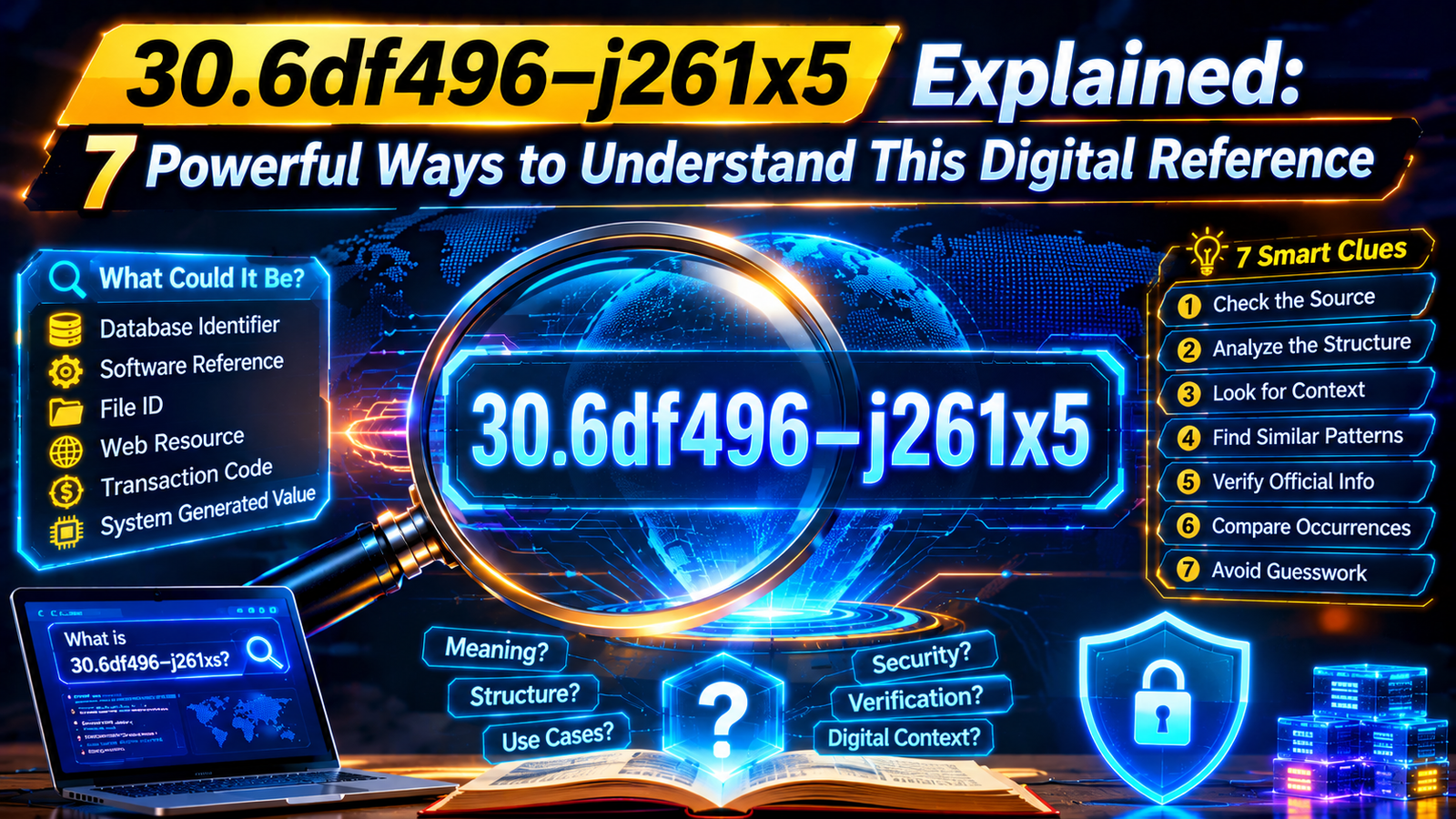
This guide presents seven powerful ways to investigate 30.6df496–j261x5 while avoiding unsupported conclusions.
The Digital Identifier at a Glance
Before investigating a strange reference, start with what can actually be observed.
The visible sequence contains:
30 . 6df496 – j261x5
Several features immediately stand out:
- A numerical opening
- A period separator
- A mixed alphanumeric middle section
- A dash-like separator
- A final combination of letters and numbers
This makes the sequence visually different from a conventional word, sentence, or ordinary decimal value.
The format may be compatible with a computer-generated identifier, but that observation does not reveal exactly what system created it.
That distinction is important.
A technical-looking string should not automatically be assigned a specific meaning simply because its appearance resembles other identifiers.
1. Examine the Environment First
The most valuable clue surrounding 30.6df496–j261x5 may not be inside the string at all.
It may be the environment where you found it.
Consider whether the reference appeared in:
- A website
- A mobile or desktop application
- A database
- A document
- A file name
- A technical message
- An online platform
- A digital resource
The same sequence could potentially serve different purposes in different environments.
For example, an identifier displayed in software could refer to an internal object, while a similar-looking value in an inventory system might represent a record.
Read more: What Is 30.6df496–j261x5? 7 Powerful Insights to Decode the Digital Code
Context Beats Guesswork
Suppose you find the string without any additional information.
You can observe its structure, but you cannot reliably determine its purpose.
Now imagine you also know the application, page, field name, and surrounding text.
The possible interpretations become much narrower.
This is why the first rule for investigating 30.6df496–j261x5 is simple:
Find the source before trying to define the string.
2. Break the Reference Into Visible Sections
A second useful approach is structural analysis.
Rather than treating 30.6df496–j261x5 as one mysterious object, examine its visible sections.
The Opening Number
The string begins with 30.
This could simply be a component of a larger generated value.
There is no reliable evidence that this number represents a year, version, quantity, age, or other specific concept.
The Middle Sequence
The 6df496 portion contains both letters and numbers.
Mixed alphanumeric sequences are frequently used in computer-generated references because they can create a large number of possible combinations.
However, the appearance of this section does not prove that it is a hash, encryption value, product number, or another particular type of code.
The Final Segment
The j261x5 portion continues the mixed-character pattern.
Its letters and numbers may be meaningful within the system that generated the complete reference, or they may simply be part of an automatically generated identifier.
Without documentation, its individual characters should not be assigned a definite interpretation.
3. Ask What Kind of Identifier It Might Be
Once the structure and source have been examined, consider the broader categories of digital references.
30.6df496–j261x5 could potentially resemble several types of computer-generated values.
Database Reference
Databases often assign unique identifiers to records.
Software Object ID
Applications may give individual objects unique references.
File-Related Identifier
Digital platforms may associate files with generated identifiers.
Web Resource Reference
Websites can use internal values to distinguish resources or records.
Transaction Reference
Some systems generate references for individual digital transactions or events.
Automated Process Value
Background services may create identifiers while processing information.
These are possible categories, not confirmed definitions.
4. Seven Powerful Clues for Investigation
A mystery becomes easier to solve when it is divided into smaller questions.
Here are seven useful clues for understanding 30.6df496–j261x5.
Clue One: Location
Where did the reference appear?
Record the exact website, application, document, or system.
Clue Two: Surrounding Text
What words appeared next to the sequence?
Labels such as “ID,” “Reference,” “Record,” or “File” may provide valuable context.
Clue Three: Repetition
Does the same value appear more than once?
Repeated appearances may indicate that it identifies a specific resource.
Clue Four: Similar Values
Are there other references with the same general structure?
Similar values can reveal a naming or identifier pattern.
Clue Five: Timing
When did the value appear?
If it appeared immediately after a specific action, that action may help explain its purpose.
Clue Six: Source System
Which application, website, or service produced it?
Identifying the source can lead to relevant documentation.
Clue Seven: Official Evidence
Does the developer, website owner, or platform provide information about the reference?
Official documentation is generally stronger evidence than unsupported interpretations.
A Context Map for 30.6df496–j261x5
A simple context map can make the investigation more organized.
| Observation | Question to Ask |
|---|---|
| Website | Which page displayed it? |
| Application | Which program generated it? |
| File | What created or modified the file? |
| Database | What field contains the value? |
| Error message | What happened immediately before it appeared? |
| Digital platform | What resource is connected to it? |
| Repeated reference | Why does the same value appear again? |
This method prevents researchers from focusing exclusively on the characters.
5. Don’t Confuse an Identifier With a Meaningful Name
One of the most important concepts in digital systems is the difference between a name and an identifier.
A name is often created for humans.
An identifier is often created for systems.
A person might name a document “Project Report.”
A computer system could internally associate that document with a complicated reference that has no obvious meaning to the user.
This helps explain why 30.6df496–j261x5 may look random.
Its purpose may not be to describe anything.
It may simply distinguish one digital object from another.
Why Random-Looking Values Are Common
Modern software handles enormous amounts of information.
A platform may need to distinguish between thousands, millions, or even billions of records.
Readable names alone are not always practical.
Generated identifiers can solve this problem by creating values that are unique or sufficiently distinct within a particular system.
The result can look strange to humans while being perfectly ordinary to software.
Therefore, an unusual format is not automatically evidence that something is wrong.
6. Separate Confirmed Facts From Possibilities
When researching 30.6df496–j261x5, it is useful to divide information into three levels.
Confirmed
Information supported by reliable documentation or direct evidence.
Plausible
An interpretation that fits the structure or context but has not been confirmed.
Speculative
A theory based mainly on appearance or coincidence.
This classification is especially helpful when online search results provide conflicting explanations.
For example, someone might claim that the string is a particular product number. Another source might describe it as a software identifier.
Without supporting evidence, neither claim should automatically be treated as fact.
Read more: The Future of Digital Marketing in 2025: Trends Every Business Must Know
7. Use Verification Instead of Assumptions
The final and most important step is verification.
If you want to understand 30.6df496–j261x5, begin with the original source.
Preserve the Exact Reference
Copy the sequence without changing its punctuation or capitalization.
Record the Original Location
Save the website, application, page, or document where it appeared.
Capture Nearby Information
The surrounding text can be as valuable as the reference itself.
Check Relevant Documentation
If the source belongs to known software or a digital platform, look for official documentation.
Compare Multiple Examples
Other references from the same system may reveal a consistent pattern.
Avoid Unverified Definitions
Do not turn a possibility into a fact unless evidence supports it.
Is 30.6df496–j261x5 a Security Risk?
An unfamiliar reference can sometimes make users concerned about security.
However, 30.6df496–j261x5 alone does not establish that a device, website, or account has been compromised.
The broader environment is much more important.
A strange identifier appearing inside ordinary software data may be completely harmless.
On the other hand, if an unfamiliar value appears alongside a legitimate security warning or other verified issue, the surrounding event should be investigated.
The key point is that an unusual digital format is not proof of malicious activity.
Could It Be a Product or Inventory Reference?
Businesses frequently use internal references for products and inventory.
These may contain:
- Numbers
- Letters
- Short segments
- Separators
- Automatically generated values
Because of this, it is possible for a product system to contain an unusual identifier.
However, the appearance of 30.6df496–j261x5 does not prove that it is a product code.
To establish that connection, look for supporting information such as a manufacturer, catalog, product description, or official inventory documentation.
Could It Be Connected to Software?
Software is one of the most natural environments for generated identifiers.
Applications can assign references to:
- Files
- Objects
- Projects
- Sessions
- Records
- Requests
- Resources
These references may never be intended for ordinary users to interpret.
If you discovered 30.6df496–j261x5 inside an application, the application’s documentation and surrounding interface may provide more useful clues than the string itself.
Could It Appear in a Database?
Yes, unusual identifiers can occur in databases.
A database may store a reference alongside other information.
For example, a record could contain:
| Field | Example Purpose |
|---|---|
| Identifier | Distinguishes the record |
| Date | Shows when it was created |
| Status | Describes its current state |
| Type | Identifies the record category |
| Related ID | Connects it with another record |
If 30.6df496–j261x5 appeared in such an environment, the field containing it would be an important clue.
Why the Original Context Should Be Preserved
Deleting or copying only the strange sequence can remove valuable information.
Imagine finding a code inside a long technical message.
The surrounding message may explain:
- What system generated it
- What action caused it
- What resource it refers to
- Whether it is temporary
- Whether it is an error reference
Once the surrounding context is lost, identifying the reference becomes much harder.
For this reason, preserving the original context is one of the simplest ways to improve digital research.
What Not to Assume About 30.6df496–j261x5
It is tempting to give an unusual string an exciting explanation.
But responsible technical research requires restraint.
Without evidence, you should not automatically assume that 30.6df496–j261x5 is:
- A secret message
- A password
- A virus
- Malware
- A product
- A license key
- A tracking identifier
- A hacking tool
- A transaction number
Any of these interpretations would require additional evidence.
The safest description is an unidentified alphanumeric digital reference until its origin is established.
A Quick Research Workflow
If you encounter 30.6df496–j261x5, follow this simple sequence:
Observe → Record → Locate → Compare → Verify
Observe
Look at the exact structure.
Record
Copy the reference accurately.
Locate
Identify where it appeared.
Compare
Look for similar references or repeated occurrences.
Verify
Check reliable documentation and source information.
This workflow is simple enough for beginners while still being useful for technical research.
The Most Important Questions to Ask
When investigating an unfamiliar digital reference, five questions can quickly organize the research:
Where did it appear?
The location establishes the starting point.
What was happening at the time?
The action or event may reveal its purpose.
What appeared around it?
Nearby labels and text can provide important clues.
Does another example exist?
Repeated patterns can reveal how the system generates references.
Is there official information?
Reliable documentation should take priority over speculation.
These questions can make the investigation of 30.6df496–j261x5 considerably more productive.
Final Analysis
The available characteristics of 30.6df496–j261x5 show an unusual combination of numbers, letters, and punctuation.
Its appearance is consistent with the general style of many automatically generated digital references. Such values can potentially occur in software, websites, databases, files, inventory systems, or automated processes.
However, appearance alone cannot establish its exact meaning.
The strongest approach is therefore context-based investigation. Identify where the reference appeared, preserve surrounding information, compare similar values, and consult reliable documentation before reaching a conclusion.
Most importantly, avoid treating speculation as established information.
An unfamiliar digital reference may look mysterious, but it can have a very ordinary technical purpose within the system that generated it.
Frequently Asked Questions
What is 30.6df496–j261x5?
30.6df496–j261x5 is an unusual alphanumeric sequence whose exact purpose cannot be established from the characters alone.
Is 30.6df496–j261x5 a digital identifier?
It can reasonably be investigated as a possible digital identifier because of its mixed numerical and alphabetical structure, but its exact role requires contextual evidence.
Is 30.6df496–j261x5 a product code?
There is not enough information to confirm that it is a product or inventory code.
Could 30.6df496–j261x5 belong to software?
Yes, software systems commonly use generated references, but the specific application would need to be identified before confirming that connection.
Is 30.6df496–j261x5 dangerous?
The unusual appearance of the string alone does not establish that it is dangerous, malicious, or associated with malware.
How should I investigate 30.6df496–j261x5?
Start by recording the exact string and identifying where it appeared. Then examine the surrounding information, compare similar references, and check reliable documentation.
Does every part of 30.6df496–j261x5 have a hidden meaning?
Not necessarily. Some generated identifiers use characters primarily to create distinct values rather than communicate a readable message.
Conclusion
Unfamiliar digital strings can appear complicated simply because they were designed for computers rather than people.
30.6df496–j261x5 is a good example of why context matters when investigating technical references. Its mixed structure may suggest an automatically generated value, but there is not enough information in the sequence itself to establish a universal definition.
The most reliable method is to investigate the environment, preserve the original context, compare related references, and verify claims through trustworthy sources.
Instead of forcing a single explanation, treat the string as an unidentified digital reference until evidence reveals its real function.
That approach is more accurate, more responsible, and far more useful for understanding unusual technical information.
