
Introduction
Software developers often come across unusual names, technical identifiers, and version numbers that are difficult to understand at first glance. One such term is Osgartop0.9.6.3. If you have searched for what is osgartop0.9.6.3, you are likely trying to understand what the name represents, what type of software it describes, and whether it has any practical value for modern development.
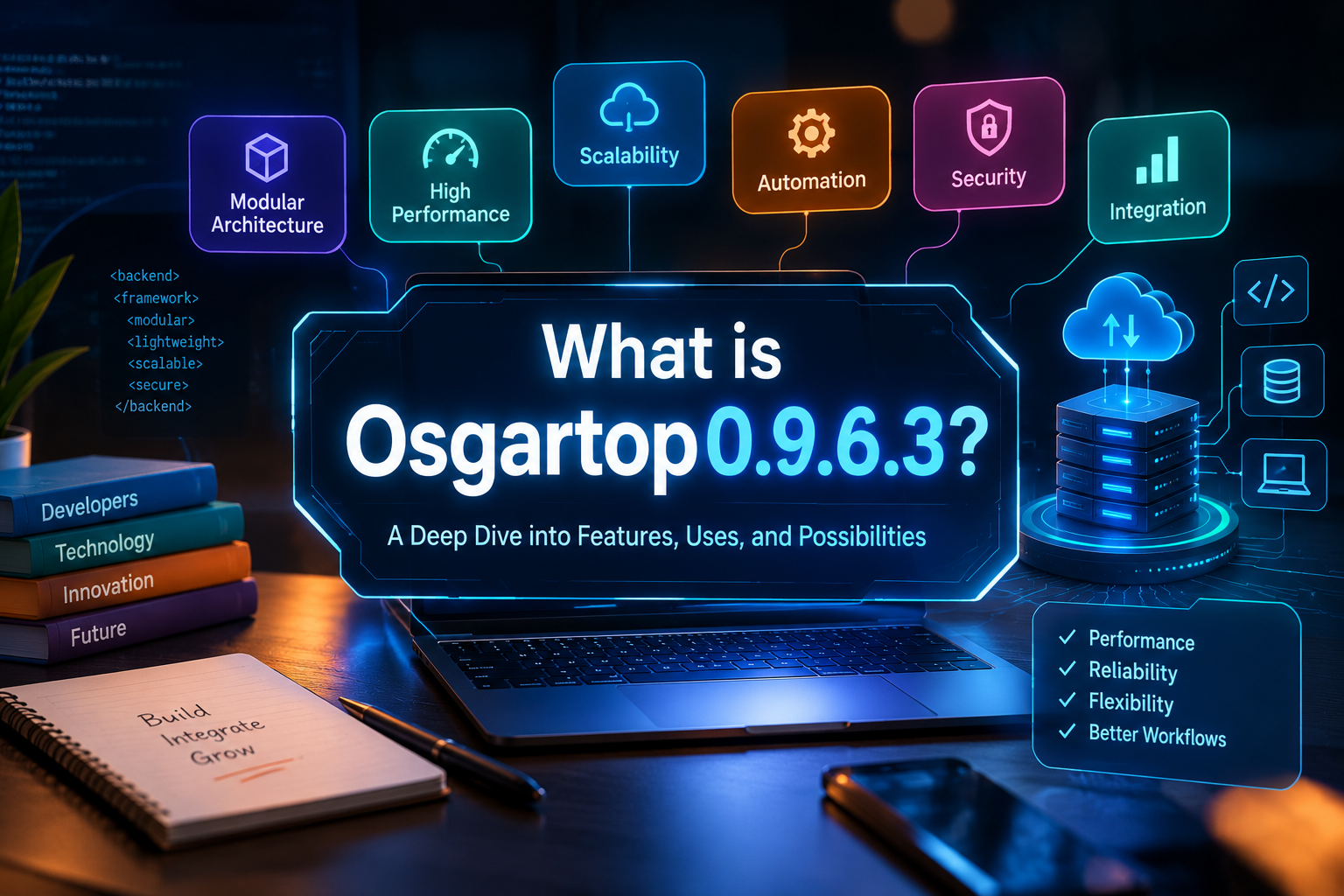
The supplied source presents Osgartop0.9.6.3 as a backend framework associated with modular architecture, lightweight execution, performance optimization, integration, automation, security, monitoring, and scalability.
Rather than simply repeating the original description, this guide takes a fresh approach. It examines the terminology, possible purpose, architecture, performance considerations, security, practical applications, limitations, and important verification steps.
Quick Explanation: What Is Osgartop0.9.6.3?
The simplest answer to what is osgartop0.9.6.3 is that the supplied source describes it as a backend framework version designed around efficient server-side operations.
Backend frameworks generally provide developers with organized structures for building and managing the part of an application that operates behind the visible interface. These systems can deal with APIs, data processing, authentication, automation, services, and communication between different software components.
The source specifically associates Osgartop0.9.6.3 with modularity and lightweight execution, suggesting an emphasis on flexibility and efficient resource use.
However, developers should distinguish between information published on the supplied page and independently verified official documentation.
1. Understanding the Unusual Version Number
A useful starting point for what is osgartop0.9.6.3 is the version identifier itself.
The name contains the project identifier followed by 0.9.6.3. The supplied source interprets the leading zero as an indication that the framework is still within a development or pre-release stage. The later numbers suggest that multiple refinements have taken place.
Version numbers can provide useful clues, but they should not be interpreted as universal rules. Different software projects use different versioning systems.
For developers, release notes are more useful than the number alone because they explain exactly what changed between versions.
Why Version Numbers Matter
When evaluating unfamiliar software, the version number helps identify the exact release being discussed.
This matters because functionality, security, compatibility, and performance can change between releases. A tutorial written for an earlier version may not always apply to a newer one.
Therefore, anyone researching what is osgartop0.9.6.3 should confirm the version from reliable documentation before installing or testing anything.
2. A Backend Framework at Its Core
The central idea behind what is osgartop0.9.6.3 is its description as a backend framework.
Backend frameworks are used to organize server-side application logic. Depending on their capabilities, they can provide structures for APIs, data handling, authentication, workflows, services, and other background processes.
This makes the concept different from a typical desktop application that users open simply to perform everyday tasks.
Instead, a backend framework generally becomes part of a larger software architecture.
Why Backend Architecture Matters
A poorly organized backend can become difficult to maintain as an application grows.
A structured framework can provide conventions and reusable components that help developers keep different parts of an application organized.
This is one reason what is osgartop0.9.6.3 is relevant to developers interested in modern backend architecture.
3. Modular Architecture and Flexibility
One of the strongest themes in what is osgartop0.9.6.3 is modular design.
According to the supplied source, the framework’s modular architecture allows developers to select components according to their requirements. This approach can reduce unnecessary overhead and make maintenance easier.
Imagine a backend application divided into several functional areas:
- Authentication
- APIs
- Data processing
- Logging
- Automation
- Monitoring
- External integrations
A modular approach can keep these responsibilities more clearly separated.
Benefits of Modular Design
Modularity can make software easier to update because developers may be able to modify individual components without rebuilding the entire system.
It can also help teams understand large projects more easily.
For someone researching what is osgartop0.9.6.3, this modular approach is one of the most important concepts to understand.
Read more: 30.6df496–j261x5: 7 Powerful Ways to Understand a Mysterious Digital Identifier
4. Lightweight Resource Management
Another important part of what is osgartop0.9.6.3 is its reported lightweight design.
The source describes the framework as minimizing unnecessary resource consumption. Efficient resource management can be particularly useful when applications operate on limited hardware or environments where computing resources have a cost.
Cloud servers, smaller development machines, and edge-oriented environments can all benefit from efficient software.
However, a framework being described as lightweight does not automatically mean it will outperform every alternative.
Actual performance depends on:
- Application architecture
- Hardware
- Database design
- Network conditions
- Workload
- Configuration
- Dependencies
For that reason, developers should test real workloads instead of relying only on general descriptions.
5. Performance Optimization
Performance is another major element when explaining what is osgartop0.9.6.3.
The source associates the framework with execution-pipeline optimization, memory allocation improvements, and reduced latency during processing.
These areas can influence how efficiently backend applications respond to requests.
What Can Affect Backend Performance?
Even an optimized framework cannot solve every performance problem.
For example, an application can still become slow because of inefficient database queries, excessive network requests, poor caching, insufficient server resources, or inefficient application code.
Therefore, performance should be measured using benchmarks and monitoring tools.
A useful development process normally includes testing before deployment and continued performance monitoring afterward.
6. Stability and Reliability
When investigating what is osgartop0.9.6.3, stability is another important consideration.
Backend applications often need to operate continuously. Unexpected errors can affect services, users, and connected systems.
The supplied source associates Osgartop0.9.6.3 with error handling and logging capabilities intended to improve system reliability.
Why Logging Is Important
Logs provide information about what happened inside an application.
Developers can use them to investigate:
- Failed requests
- Configuration problems
- Unexpected behavior
- Performance issues
- Service interruptions
Good logging can therefore reduce the time required to identify technical problems.
7. Compatibility and Integration
A modern application rarely exists in isolation. It may need to communicate with databases, APIs, operating systems, cloud services, and external tools.
This is why compatibility is an important part of what is osgartop0.9.6.3.
The supplied source describes the framework as being designed to work across different environments and integrate with third-party tools.
Before adopting any unfamiliar framework, developers should confirm:
- Supported operating systems
- Runtime requirements
- Programming-language support
- Database compatibility
- API capabilities
- Third-party integrations
- Deployment requirements
Testing these areas early can prevent expensive compatibility problems later.
Security and Data Protection
Security deserves special attention in any backend discussion. Understanding what is osgartop0.9.6.3 therefore also requires looking at its reported security-related capabilities.
The source mentions authentication protocols, access controls, and data-integrity mechanisms.
Authentication deals with establishing identity, while access controls determine which resources an authenticated user or service can access.
Data integrity focuses on keeping information accurate and protected from unauthorized changes.
Security Is More Than a Feature List
A framework cannot guarantee complete application security by itself.
Developers still need to:
- Protect passwords and credentials
- Apply appropriate permissions
- Validate incoming data
- Keep dependencies updated
- Monitor suspicious activity
- Test application security
- Maintain secure backups
This is especially important for applications handling sensitive information.
Workflow Automation and Productivity
Another useful angle when asking what is osgartop0.9.6.3 is workflow automation.
The supplied source describes automation features related to task management and process efficiency.
Automation can reduce repetitive manual work.
For example, backend systems may need to process scheduled tasks, move information between services, generate reports, or perform recurring operations.
Automating these processes can improve consistency and reduce the possibility of human error.
Where Automation Can Help
Automation may be useful for:
- Scheduled jobs
- Data processing
- System notifications
- Workflow management
- Service coordination
- Repetitive backend operations
The exact capabilities should still be confirmed through current technical documentation.
Monitoring, Diagnostics, and Troubleshooting
A complete explanation of what is osgartop0.9.6.3 should not ignore monitoring.
Backend systems need visibility so developers can understand how applications behave over time.
The supplied source highlights monitoring, logging, and diagnostic capabilities for tracking system behavior and identifying potential problems.
Monitoring can help teams identify unusual resource consumption or service failures before they become larger problems.
Diagnostics can then help developers investigate the underlying cause.
This combination can be especially valuable for applications that need consistent availability.
Possible Real-World Applications
The practical meaning of what is osgartop0.9.6.3 becomes clearer when considering potential use cases.
The supplied source mentions software development, APIs, backend services, enterprise environments, workflow management, system monitoring, and educational applications.
Software Development
Developers could potentially use a backend framework to structure APIs and server-side services.
Enterprise Systems
Organizations may need systems that process information, communicate between services, and support internal workflows.
Education
A framework can also provide a practical example for students learning concepts such as backend architecture, modular systems, APIs, and performance management.
These are potential applications described by the source and should not be interpreted as proof that the framework is currently deployed in every listed industry.
Read more: Top 10 AI Applications Streamlining Supply Chain and Logistics in 2025
Scalability and Long-Term Growth
Scalability is another key consideration in what is osgartop0.9.6.3.
A scalable system should be capable of handling increasing workloads and changing requirements without requiring an entirely new architecture.
The source links scalability with the framework’s modular structure, suggesting that components can be expanded as requirements change.
However, scalability depends on more than the framework.
Other factors include:
- Database architecture
- Server infrastructure
- Caching
- Networking
- Application design
- Load management
- Deployment strategy
Therefore, developers should perform realistic load testing before making scalability decisions.
Common Challenges to Expect
When researching what is osgartop0.9.6.3, it is equally important to understand possible limitations.
The supplied source identifies configuration errors, compatibility conflicts, and performance bottlenecks as potential challenges.
Configuration Issues
Incorrect settings can prevent services from communicating properly or cause unexpected application behavior.
Compatibility Problems
Different libraries, runtimes, operating systems, or external services can create conflicts.
Performance Bottlenecks
An application can become slower as workloads increase, especially if databases, networks, or application code are not optimized.
The best approach is systematic testing, log analysis, configuration review, and performance measurement.
A Smart Evaluation Checklist
Before deciding what is osgartop0.9.6.3 means for your project, check these points:
1. Documentation
Look for clear and current technical documentation.
2. Developer Information
Confirm who maintains the project and where official information is published.
3. Version History
Review release notes and update history.
4. Licensing
Understand whether the software’s license permits your intended use.
5. Compatibility
Confirm supported operating systems, runtimes, databases, and dependencies.
6. Security
Look for security advisories and information about vulnerability management.
7. Maintenance
Check whether the project is actively maintained.
These checks can provide a much stronger basis for evaluating unfamiliar software.
Is It Ready for Production?
The source describes Osgartop0.9.6.3 as being in a development or pre-release stage.
Therefore, what is osgartop0.9.6.3 should not be interpreted as an automatic recommendation to deploy it in a business-critical environment.
Production software should be evaluated through controlled testing.
A development team should examine stability, security, documentation, compatibility, dependencies, performance, support, and recovery procedures before making a final decision.
For learning or experimentation, the evaluation requirements may be less demanding. For critical systems, the standard should be much higher.
Frequently Asked Questions
What is osgartop0.9.6.3?
It is described by the supplied source as a backend framework version focused on modular architecture, performance, automation, security, monitoring, and scalability.
Is Osgartop0.9.6.3 a backend framework?
Yes. The supplied source presents it as a lightweight and modular backend framework or system utility.
What does version 0.9.6.3 mean?
It identifies a particular software release. The leading zero may indicate a development-stage version, although exact versioning conventions depend on the project.
Does it support automation?
The source associates the framework with workflow automation, task management, and process efficiency.
Can it integrate with other systems?
The supplied description says it is designed to work with different environments and third-party tools.
Is it scalable?
Scalability is one of the capabilities discussed by the source, although actual scalability depends on the complete application architecture.
Is it suitable for beginners?
It may be useful for learners studying backend architecture, but beginners should use reliable documentation and controlled testing.
What should developers verify first?
They should verify official project information, documentation, licensing, compatibility, security, dependencies, maintenance, and release history.
Final Verdict
So, what is osgartop0.9.6.3? Based on the supplied source, it is presented as a development-stage backend framework built around modular architecture, lightweight execution, performance optimization, integration, automation, security, monitoring, reliability, and scalability.
The strongest idea behind the framework is its modular approach. Separating functionality into manageable components can make software easier to organize, maintain, and expand.
Its reported focus on resource efficiency and performance may also make the concept interesting for developers studying modern backend architecture.
At the same time, users should not rely on a single descriptive article when making production decisions. Official documentation, developer identity, licensing, security information, dependencies, release history, and real-world testing should all be checked first.
Ultimately, the best answer to what is osgartop0.9.6.3 depends on how the software is documented, maintained, tested, and used in a particular development environment.
