
Introduction
Food information is changing as manufacturers, retailers, and digital platforms introduce new ways to organize product records. Consumers now encounter traditional ingredient labels alongside barcodes, batch references, QR codes, and technical strings that may not be immediately understandable. This creates an important challenge: how can people investigate unfamiliar information without confusing assumptions with verified facts?
The topic of 30.6df496–j261x5 in food provides an opportunity to explore a broader issue: responsible interpretation of unusual identifiers in food-related information. An unfamiliar sequence might appear in an online article, product record, technical document, or packaging reference, but its appearance alone cannot establish its purpose.
This guide introduces practical research strategies, explains how to evaluate digital food information, and highlights common mistakes to avoid. Rather than assigning an unsupported meaning to an unfamiliar code, the focus is on evidence, transparency, and informed consumer decisions.
1. Begin With the Context, Not the Code
The first step in investigating any unfamiliar identifier is to understand where it appears. A sequence printed near a manufacturing date may serve a different purpose from a similar sequence found in a software database or an online discussion.
When examining 30.6df496–j261x5 in food, record the surrounding information before deciding what it might represent. Note the product name, document heading, website address, and any nearby description. These details help establish the context in which the sequence is being used.
Avoid drawing conclusions from the combination of letters, numbers, and punctuation alone. Technical-looking text does not automatically represent a chemical ingredient, safety certification, or recognized industry standard. Context provides the starting point for further verification.
2. Distinguish Public Information From Internal References
Businesses often maintain internal records to organize inventory, production schedules, shipments, and customer orders. Some references are designed for internal use and may not have a publicly documented meaning.
The phrase 30.6df496–j261x5 in food should therefore be evaluated against the specific source where it appears. If it is mentioned in a company document, look for definitions, abbreviations, or a glossary that explains the terminology.
If no explanation is available, contact the organization responsible for the document. Do not assume that a code used by one business has the same meaning elsewhere. Similar formats can be used for unrelated purposes, making direct source confirmation especially important.
3. Use Search Engines as Research Tools, Not Final Authorities
Online searches can help locate relevant documents, discussions, and official product information. However, search results may contain outdated pages, copied statements, incomplete snippets, or material unrelated to the original question.
A search for 30.6df496–j261x5 in food should be treated as the beginning of research rather than proof of a particular interpretation. Open relevant pages, inspect their publication dates, and identify who is responsible for the information.
Compare claims against primary sources whenever possible. If several websites repeat the same explanation but none links to supporting documentation, the repetition does not independently verify the claim. Reliable research depends on evidence that can be examined, not simply on the number of pages making a statement.
Read more: CryptoProNetwork Com Adrian: 7 Essential Facts, Content Guide & Smart Tips
4. Evaluate the Credibility of a Source
Not every website has the same level of expertise or accountability. A manufacturer’s product specification, an official regulatory notice, a scientific publication, and an anonymous social media post serve different purposes and deserve different levels of scrutiny.
Before accepting a claim about 30.6df496–j261x5 in food, check the publisher’s identity, relevant expertise, supporting references, and date of publication. Determine whether the page presents original evidence or merely repeats information from another source.
Look for clear distinctions between established facts, interpretation, and speculation. A trustworthy explanation should make its reasoning understandable and provide enough detail for readers to investigate independently. When a source cannot demonstrate how it reached a conclusion, treat that conclusion cautiously.
5. Understand the Difference Between Food Data and Food Safety
Food-related information can describe many different things, including ingredients, nutritional values, production records, distribution details, and safety assessments. These categories should not be confused simply because they appear on the same page or package.
Research involving 30.6df496–j261x5 in food should distinguish an unidentified reference from an actual safety finding. An unfamiliar sequence does not establish that a product is contaminated, dangerous, approved, or free from risk.
For safety questions, examine the complete label and consult the relevant manufacturer or food-safety authority. If an official recall or warning exists, follow the instructions from the responsible organization. Where evidence is unavailable, state what remains unknown instead of making a confident claim that cannot be supported.
6. Examine Packaging Information Systematically
Packaging often provides several useful clues about a product. Depending on local requirements and the product type, these may include the product name, ingredient declaration, allergen information, quantity, manufacturer details, storage guidance, and date markings.
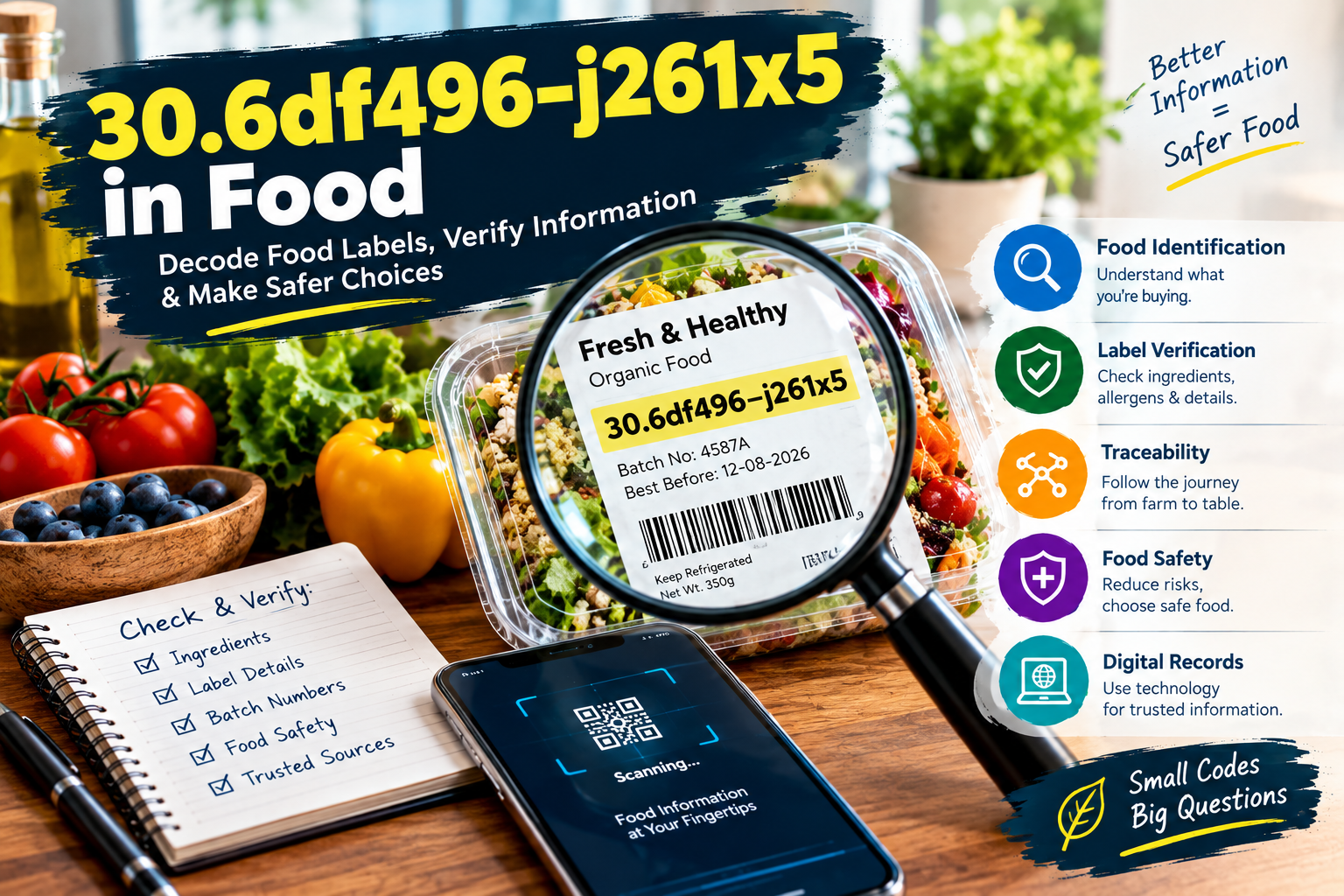
If 30.6df496–j261x5 in food appears on a package, inspect the surrounding text and identify which section contains it. Its position might suggest a possible relationship to other information, but position alone does not prove the sequence’s function.
Take a clear photograph of the entire label, including the front, back, and any small-print details. Keep the original spelling and punctuation when recording the identifier. If the label is unclear or important information is missing, request clarification rather than relying on an online guess.
7. Explore Traceability Without Making Assumptions
Food traceability helps organizations follow products through different stages of production and distribution. Depending on the system, records may connect suppliers, manufacturing facilities, storage locations, shipment details, and retail destinations.
The appearance of 30.6df496–j261x5 in food does not establish that it belongs to a traceability system. To determine whether that is the case, look for documentation that explicitly connects the identifier to a product record or tracking process.
If a manufacturer confirms that a sequence is associated with a batch or shipment, ask what information it can provide and whether that information applies to the particular item being examined. Do not interpret an identifier as proof of a product’s complete history unless the underlying records support that conclusion.
8. Protect Personal Information During Online Research
Researching product information should not require unnecessary disclosure of personal data. Some websites may request registration, contact details, payment information, or software downloads before allowing access to an explanation.
When investigating 30.6df496–j261x5 in food, begin with ordinary searches and reputable public sources. If a company requires additional details to identify a product, provide only the information reasonably needed for that request.
Be cautious with unfamiliar links, suspicious attachments, and websites that use alarming claims to pressure visitors into immediate action. Avoid sharing account credentials or payment information merely to learn the meaning of a code. Responsible research includes protecting both the accuracy of your conclusions and the security of your personal information.
9. Recognize Common Research Mistakes
Several mistakes can make an investigation less reliable. One is assuming that a technical-looking sequence must have a technical definition. Another is accepting an explanation because it appears on a polished website or is repeated across several pages.
When researching 30.6df496–j261x5 in food, also avoid confusing similarly written identifiers. A small difference in a letter, digit, or punctuation mark can lead to a completely different result.
Another common problem is ignoring the date and context of a source. An older document may refer to a different product or system, while a discussion may describe an unverified interpretation. Keep your search focused on the exact sequence and check whether each source actually addresses the same subject.
10. Ask Better Questions When Contacting a Company
A clear question can help a manufacturer or retailer provide a useful answer. Instead of asking only whether a code is safe, explain where it appears and what information you need clarified.
If you are researching 30.6df496–j261x5 in food, ask whether the organization recognizes the exact sequence and whether it identifies a product, batch, internal reference, or another type of record. Include a photograph of the label when appropriate.
Provide the brand and product name, along with relevant packaging details. Keep the message factual and avoid suggesting an interpretation that has not been established. If the company responds, retain the answer and any supporting documents so the information can be checked later.
11. Turn Research Findings Into Responsible Consumer Decisions
Research is most useful when it helps people understand what is known, what remains uncertain, and which steps are reasonable next. A verified ingredient declaration may answer one question, while a manufacturer response may be needed to clarify an unfamiliar reference.
The investigation of 30.6df496–j261x5 in food should lead to a conclusion that matches the available evidence. If reliable documentation identifies the sequence, summarize that explanation with its source. If no dependable source confirms its meaning, clearly describe it as unidentified.
For everyday food decisions, continue to review the product’s ingredient information, relevant date markings, storage requirements, packaging condition, and any applicable official notices. These practical checks are more informative than guessing the meaning of a single unexplained string.
Read more: Smart Pest Control: Combining Technology and Traditional Methods
Conclusion
Digital information can make food records easier to organize and investigate, but it can also introduce unfamiliar terminology that consumers may struggle to interpret. Careful research helps separate useful evidence from speculation and prevents unsupported explanations from spreading.
Ultimately, 30.6df496–j261x5 in food should be approached through context, source verification, and transparent reasoning rather than assumptions. Check the original document, compare reliable references, contact the responsible organization when necessary, and distinguish confirmed facts from unresolved questions.
A code does not explain itself. Its meaning must come from credible documentation or an authoritative explanation. By applying consistent research habits and maintaining appropriate caution, readers can evaluate unfamiliar food information more effectively and make decisions based on evidence instead of guesswork.
