
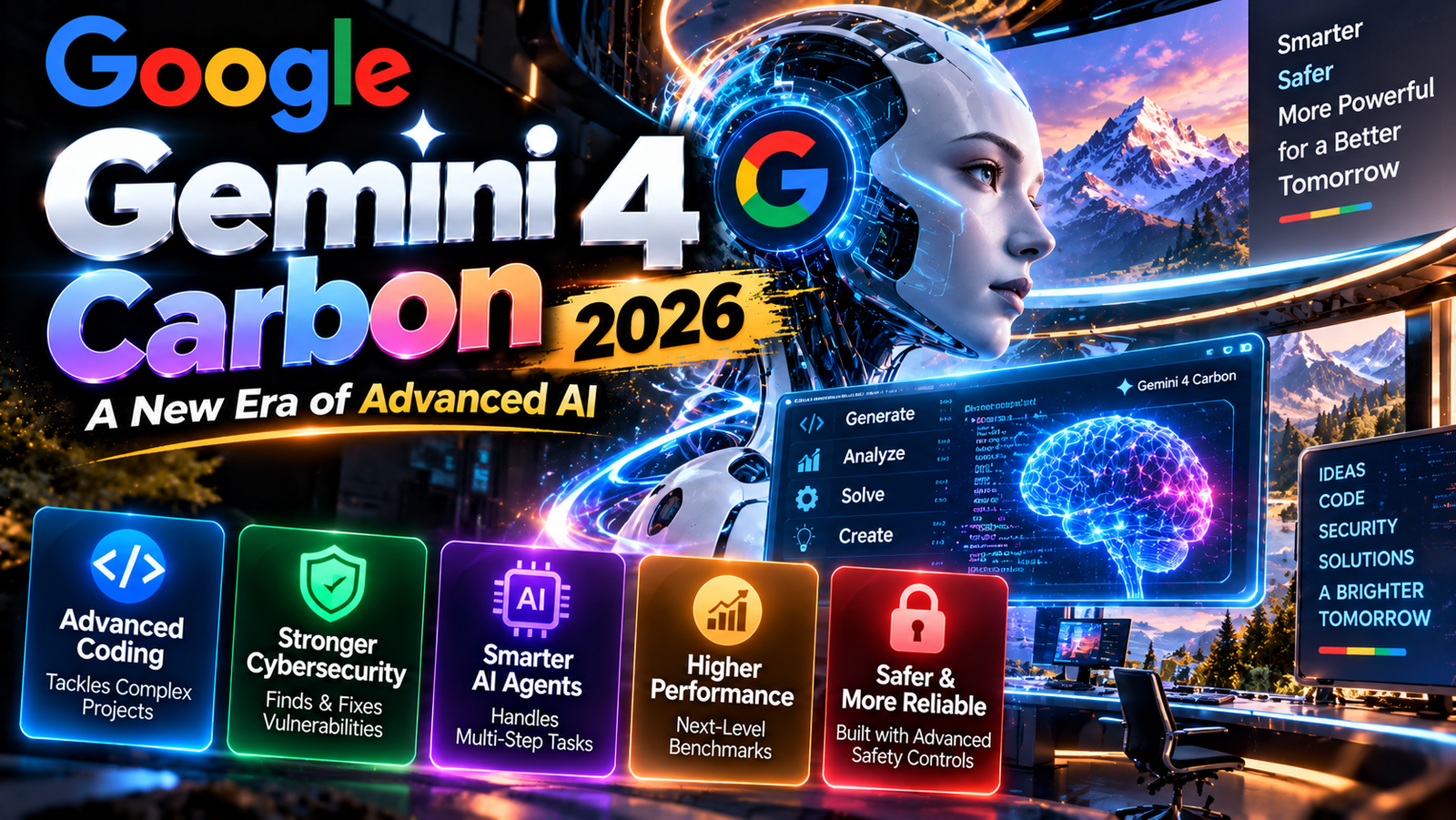
Artificial intelligence is moving beyond answering simple questions toward completing complex tasks that require planning, coding, research, and multiple steps. Google DeepMind’s latest announcement reflects this shift by introducing a model designed for demanding engineering and cybersecurity work.
Google Gemini 4 Carbon was announced on October 28, 2026, as Google’s latest frontier model. The company describes it as a major advance in long-horizon capabilities, coding, and cybersecurity defense. Rather than focusing only on everyday chatbot conversations, the model is designed to work through difficult problems that may require repeated testing and correction.
This guide explores the model’s main capabilities, reported benchmarks, security safeguards, pricing, and expected availability. It also explains what developers, businesses, and cybersecurity professionals should consider before adopting this technology.
1. What Is Google Gemini 4 Carbon?
Google DeepMind positions this model as part of its Gemini 4 family. It follows Gemini 4 Argon and is designed to handle more demanding software engineering, reasoning, and security tasks.
Google Gemini 4 Carbon is particularly relevant to developers who work with large codebases, complicated bugs, and multi-stage engineering projects. Instead of generating a single code snippet and stopping, a capable agentic model can plan an approach, inspect results, identify problems, and continue working toward a solution.
This approach may help with tasks such as debugging, software maintenance, code review, and technical research. However, model-generated output still needs to be checked, tested, and reviewed by qualified people.
For organizations exploring Google Gemini 4 Carbon, the main question is not simply whether the model can produce code. It is whether it can complete difficult workflows reliably while respecting project requirements and security boundaries.
Official announcement: Google DeepMind introduces Gemini 4 Carbon.
2. Advanced Coding and Long-Horizon Tasks
One of the most important capabilities is sustained work on complex engineering problems. Google says its internal teams have observed the model working for days on multi-step tasks, including identifying root causes and fixing subtle bugs across large codebases and low-level systems.
Google Gemini 4 Carbon is designed for problems that cannot always be solved with one short response. These workflows may involve reading existing code, forming hypotheses, running tests, correcting mistakes, and validating a final change.
For software teams, this could reduce some repetitive debugging work and help engineers investigate complicated technical issues. It may also support full-stack development, where front-end interfaces, back-end logic, and application behavior must work together.
Long-running work introduces important challenges, however. A model can misunderstand requirements, make an incorrect assumption, or produce a change that passes one test but breaks another. Developers should use version control, automated testing, and code review when evaluating generated changes.
The practical value of Google Gemini 4 Carbon will depend on how consistently it completes these tasks in real development environments, not just on isolated demonstrations.
3. Cybersecurity: Finding Software Vulnerabilities
Cybersecurity is a central focus of this release. Modern applications can contain weaknesses hidden in complex interactions between components, permissions, data processing, and network services. Finding these problems requires careful investigation and technical reasoning.
Google reports that Google Gemini 4 Carbon achieved 88.2% on SEC-bench Pro, a benchmark associated with finding vulnerabilities in real-world software. The company also reports a 54.8% result on ExploitGym, which evaluates exploitation-related capabilities.
These results are important because security teams need more than tools that simply flag suspicious code. They need ways to investigate whether a weakness is real, understand its impact, and determine how it can be addressed.
A benchmark result does not mean every vulnerability will be found or that every assessment will be correct. Results can also depend on the benchmark methodology and evaluation conditions.
When deployed responsibly, Google Gemini 4 Carbon could assist authorized security professionals with vulnerability research, triage, and defensive testing. Testing should remain within approved systems and clearly defined permissions.
Read more: about zarovviraf153: 9 Expert Techniques to Evaluate an Unfamiliar Online Term
4. Automated Vulnerability Fixes and Secure Coding
Finding a vulnerability is only part of the security process. Teams must also understand its root cause, develop a reliable correction, and verify that the change does not introduce new problems.
Google reports that Google Gemini 4 Carbon scored 71.0% on CWE-bench, a benchmark focused on patching vulnerabilities. The company also says the model achieved more than twice the success rate of Gemini 4 Argon for generating secure code in internal evaluations.
These figures suggest that Google is focusing on the complete defensive workflow: identifying weaknesses, validating risk, and producing possible fixes. This could help development teams prioritize security issues and prepare patches more efficiently.
Nevertheless, AI-generated security patches must be reviewed. A patch may solve one problem while creating another, and changes to authentication, authorization, or data handling can have serious consequences if implemented incorrectly.
Organizations considering Google Gemini 4 Carbon should combine AI assistance with code review, regression tests, dependency checks, and human approval before deploying security-sensitive changes.
5. AI Agents and Complex Workflows
An AI agent is designed to do more than provide an answer. Depending on its tools and permissions, it may plan actions, use software, inspect results, and continue through multiple stages of a task.
Google Gemini 4 Carbon is designed for these longer workflows, including engineering and agentic tasks. This makes it relevant to projects where a user needs a sequence of actions rather than a single explanation.
For example, a software team might use an agentic workflow to investigate a bug, prepare a proposed fix, run a test suite, and summarize the changes. The model’s effectiveness would depend on its access to tools, the quality of the test environment, and the safeguards around its actions.
Google also reports improvements in computer-use benchmarks and knowledge-work tasks. These evaluations measure particular capabilities, so they should not be interpreted as proof that every real-world workflow can be automated safely.
The opportunity with Google Gemini 4 Carbon is to reduce repetitive work while keeping people responsible for important decisions. Clear permissions, audit logs, and approval checkpoints remain essential.
6. Benchmark Results and Model Performance
Benchmarks offer one way to compare AI systems, but no single score explains overall quality. Different evaluations measure different capabilities, and performance in a controlled test may not translate directly to everyday use.
Google Gemini 4 Carbon scored 59 on the Artificial Analysis Intelligence Index version 5.0, according to Google DeepMind. Google lists it ahead of Gemini 4 Argon on this index, which received a score of 50 in the published comparison.
The company also reports results across coding, computer use, multimodal understanding, science, and cybersecurity benchmarks. These comparisons suggest that the model is designed to perform across several demanding technical areas rather than specializing exclusively in one narrow task.
Readers should look at benchmark definitions before drawing conclusions. A score can depend on the test set, model configuration, tools available during evaluation, and whether safety restrictions are enabled.
For businesses considering Google Gemini 4 Carbon, a practical pilot using their own representative tasks may provide more useful evidence than relying on headline rankings alone.
7. Safety, Alignment and Prompt-Injection Resistance
More capable AI systems need strong safeguards, especially when they can interact with code, software tools, or sensitive business environments.
Google says Google Gemini 4 Carbon builds on the safety framework used for Gemini 4 Argon. This includes model training, real-time misuse defenses, prompt-injection resilience, and monitoring methods intended to identify problematic behavior.
The company reports a 0.0% attack success rate on the evaluated Gray Swan Indirect Prompt Injection benchmark. This means no successful attacks were recorded in that specific evaluation; it does not establish that every possible prompt-injection attack will fail in real-world conditions.
Google also reports improvements in reducing unsupported claims and following project constraints during multi-step work. These are meaningful goals because unreliable information or unauthorized actions can undermine trust in AI-assisted workflows.
Organizations adopting Google Gemini 4 Carbon should still apply least-privilege access, sandboxing, human approval for sensitive actions, and monitoring. Security evaluations are useful evidence, but they cannot replace a complete organizational security program.
8. Pricing and API Cost Considerations
Google announced introductory API pricing of $2 per million input tokens and $10 per million output tokens, matching the introductory price announced for Gemini 4 Argon. Google says these prices will later increase to $4 per million input tokens and $20 per million output tokens after the introductory period.
For businesses, the difference between input and output pricing matters. Input tokens include the content provided to the model, while output tokens cover generated responses. Long prompts, large codebases, repeated agent steps, and extensive outputs can all affect costs.
Before using Google Gemini 4 Carbon at scale, teams should estimate token consumption, test representative workflows, and monitor spending. An agent that performs many actions may consume considerably more tokens than a simple question-and-answer interaction.
Pricing alone does not determine value. A more expensive model may be worthwhile for a task that it completes more reliably, while a smaller model may be sufficient for routine work.
Check the official Google AI and Gemini documentation for updated information before building a production integration.
9. Availability and Who Can Use It?
Google’s initial rollout is deliberately limited. The company says Google Gemini 4 Carbon will first be available to a subset of cybersecurity defenders and will gradually expand access to additional trusted partners through its Fairwind Program.
Google has said it intends to bring the model to developers, businesses, and consumers through its products in the future. That broader release should not be confused with general availability today.
For developers, this means checking current eligibility and program requirements rather than assuming that a public announcement provides immediate API access. Businesses should also evaluate whether their intended use case is supported under the current rollout.
Cybersecurity professionals who qualify for the initial program may be able to assess the model for defensive work within the applicable rules. Other users should monitor Google’s official channels for access updates.
The release strategy for Google Gemini 4 Carbon highlights the challenge of deploying powerful AI systems: organizations want useful capabilities, but they also need time to test safeguards and understand real-world risks.
10. How Businesses and Developers Can Prepare
Organizations do not need to wait for broad access to improve their AI adoption plans. They can identify repetitive technical tasks, document existing workflows, define success metrics, and prepare safe testing environments.
Before adopting Google Gemini 4 Carbon, businesses should identify a small set of measurable use cases. Examples include bug triage, code review assistance, documentation, authorized vulnerability analysis, and test generation.
A useful pilot should compare AI-assisted work with the current process. Measure completion rates, time saved, error rates, security findings, and the amount of human review required. Include difficult cases rather than testing only easy examples.
Teams should also establish data-handling rules. Source code, customer records, credentials, and internal documents may have different sensitivity levels, so access policies should reflect those risks.
Finally, define which actions the model can take independently and which require approval. With Google Gemini 4 Carbon, careful workflow design may be just as important as the underlying model’s raw capability.
Read more: How Anesthesiologists Ensure Patient Safety During Surgery
Frequently Asked Questions
What is Google Gemini 4 Carbon?
It is Google’s frontier AI model announced on October 28, 2026, with a focus on advanced coding, long-horizon tasks, and cybersecurity defense.
Is it available to everyone?
No. Google initially plans to provide access to selected cybersecurity defenders and trusted partners through its Fairwind Program, with wider access expected later.
What makes it different from Gemini 4 Argon?
Google reports stronger performance on several coding and cybersecurity benchmarks, alongside improvements in secure code generation and complex multi-step workflows.
How much does the API cost?
The announced introductory price is $2 per million input tokens and $10 per million output tokens. Google says later pricing will be $4 and $20 per million tokens, respectively.
Can it replace cybersecurity professionals?
No. It may assist with parts of defensive security work, but professionals must validate findings, assess risk, approve changes, and oversee deployment.
Final Verdict
Google’s latest frontier model is designed for technical work that requires more than a quick response. Its focus on long-running engineering tasks, vulnerability discovery, security patching, and agentic workflows makes it a notable development in the AI industry.
Google Gemini 4 Carbon could become useful for software teams and cybersecurity defenders who need assistance with difficult, multi-stage problems. However, its real value will depend on practical performance, access conditions, cost, and how reliably it works under appropriate safeguards.
For now, the best approach is to follow official announcements, review the published benchmark methodology, and prepare controlled pilot projects. Strong AI capabilities can improve productivity, but reliable outcomes still require testing, security controls, and human judgment.
