
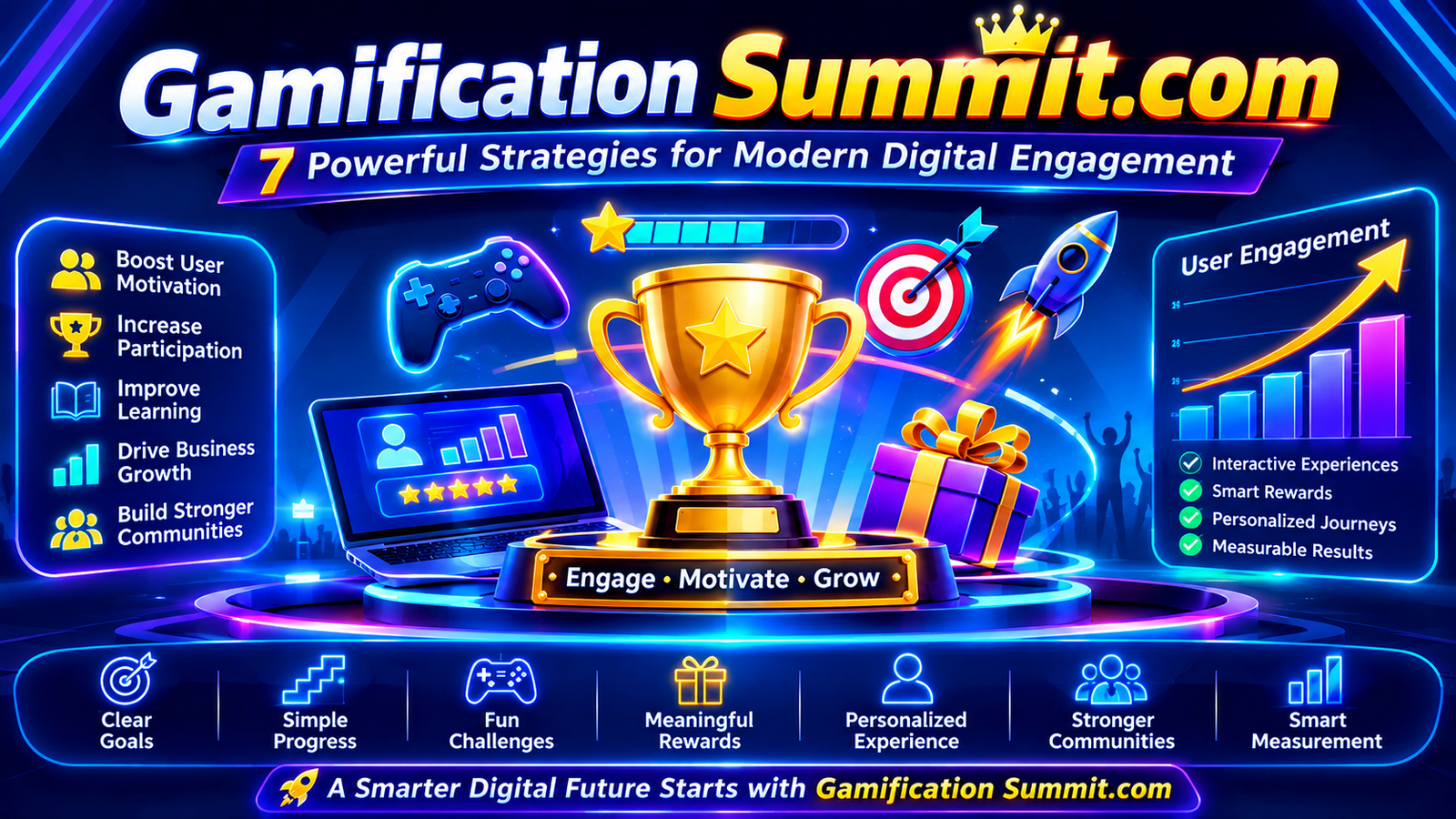
Introduction
The way people interact with digital platforms has changed significantly. Websites, applications, online communities, learning systems, business software, and mobile services now compete for attention in an increasingly crowded environment. Users expect more than basic functionality. They want experiences that are simple, interactive, understandable, and rewarding.
Gamification Summit.com provides a useful topic for exploring this changing digital landscape. Gamification refers to the use of selected game-inspired principles in environment that are not traditional games. These principles can include challenges, progress indicators, achievements, rewards, goals, feedback, levels, and recognition.
The purpose is not necessarily to make a website look like a video game. Instead, gamification can help users understand what they need to do, see their progress, and remain motivated while completing meaningful activities.
For example, an online education platform can divide a long course into several milestones. A software application can guide new customers through an onboarding process. A business can use loyalty levels to recognize returning customers. A community platform can highlight helpful contributions.
The important point is that gamification should have a clear purpose. Adding points, badges, or rankings without understanding the audience can create unnecessary complexity rather than better engagement.
This guide explores practical ways to use game-inspired ideas while keeping usability, value, and user needs at the center.
Understanding the Real Purpose of Gamification
At first glance, gamification may sound like a technology designed only for entertainment. In reality, it can be used in many different industries.
Gamification Summit.com can be understood as a broader discussion about how digital experiences can encourage useful actions through structure, feedback, progress, and motivation.
A successful system generally starts with four basic elements:
Goal → Action → Feedback → Progress
The user first needs to understand the desired outcome. Then the platform provides an action that moves the user toward that outcome. After the action, the user receives feedback. Finally, visible progress helps communicate how far they have moved.
Gamification Is Not the Same as Gaming
Gaming is usually created primarily for entertainment and play.
Gamification is different because it uses selected game-inspired mechanics for another purpose.
An educational website remains an educational website even if it uses levels. A business application remains business software even if it includes achievement milestones.
This distinction is important because it prevents organizations from adding unnecessary entertainment features.
Read more: Getwhocares.com for Gamers
Strategy 1: Begin With the User’s Objective
The first step in designing a gamified experience is identifying what the user actually needs to accomplish.
A business may want customers to complete onboarding. A teacher may want students to finish a course. A productivity application may want people to organize their tasks.
Gamification Summit.com becomes more useful when gamification is connected directly to these practical objectives.
Examples of Clear Objectives
A platform may want to:
- Increase course completion
- Improve customer onboarding
- Encourage useful community participation
- Support employee training
- Improve product discovery
- Encourage repeat engagement
- Help users complete personal goals
Once the objective is clear, the design team can decide which mechanics are necessary.
Why the Objective Comes First
Imagine an application that gives users points every time they click a button.
The point total may increase, but the user may not be accomplishing anything meaningful.
A better system rewards or recognizes actions that contribute to the intended result.
This creates a stronger connection between user activity and business objectives.
Strategy 2: Turn Long Journeys Into Manageable Stages
Large tasks can feel overwhelming when users cannot see the path ahead.
Breaking a large objective into smaller steps can make the experience easier to understand.
For example, an online course containing thirty lessons could be divided into five modules.
Module 1 → Module 2 → Module 3 → Module 4 → Final Assessment
Each stage becomes a recognizable milestone.
This is one of the practical ideas associated with Gamification Summit.com because visible progress can make a complex journey feel more manageable.
Progress Bars
A progress bar is one of the simplest gamification elements.
It can show users:
- What they have completed
- What remains
- Where they currently are
- How close they are to a goal
The design does not need to be complicated.
Meaningful Progress Matters
Progress should represent real achievement.
If users receive progress merely for opening a page, the indicator may become less meaningful.
A better approach is to connect progress with useful actions.
For example, completing a lesson can increase course progress, while completing an important setup step can increase onboarding progress.
Strategy 3: Design Better Challenges
Challenges can give users a specific reason to take action.
They can be personal, collaborative, or competitive depending on the environment.
Gamification Summit.com can also be viewed through the concept of challenges because challenges can transform vague objectives into specific tasks.
Personal Challenges
Personal challenges allow users to focus on improving their own performance.
A productivity application might allow someone to complete a weekly target.
A learning platform could encourage a student to finish several practice exercises.
This approach does not require comparison with other users.
Collaborative Challenges
Groups can also work toward shared objectives.
For example, employees could complete a training program as a team.
A community could work together toward a shared contribution milestone.
Collaboration can create engagement without creating unnecessary competition.
Competitive Challenges
Competition can be effective in some situations.
Leaderboards, rankings, and score comparisons may appeal to users who enjoy competition.
However, not every audience responds positively to rankings.
A flexible platform should consider whether competition actually supports the objective.
Strategy 4: Use Rewards That Actually Matter
Rewards are commonly associated with gamification, but not every reward needs to be physical or financial.
Gamification Summit.com can be explored through different reward models, including recognition, achievements, certificates, access, discounts, and milestones.
Read more: 7 Lighting Mistakes That Make Your Home Look Cheap
Examples of Digital Rewards
A platform might offer:
- Achievement badges
- Certificates
- Discount codes
- Exclusive content
- New feature access
- Membership levels
- Community recognition
- Special milestones
The best option depends on the user’s motivation.
Recognition Can Be Powerful
A reward does not always have to cost money.
In an online community, recognizing a helpful contributor may be more valuable than giving a random digital badge.
In education, a certificate can represent genuine achievement.
In professional training, completing a skill level can communicate progress.
Avoid Reward Inflation
If users receive rewards for every tiny action, the rewards can lose their meaning.
A smaller number of meaningful achievements may create a stronger experience.
Strategy 5: Improve Online Learning
Education is one of the most practical areas for gamification.
Online students often have to navigate lessons, assignments, exercises, tests, and projects.
Without a clear structure, a long course can feel difficult to manage.
Gamification Summit.com offers useful concepts for thinking about how learning journeys can be divided into smaller and more visible stages.
A Structured Learning Journey
A course could follow this pattern:
Discover → Learn → Practice → Test → Improve → Complete
Each stage has a clear purpose.
Students can see what they have completed and what remains.
Learning Should Stay at the Center
Gamification should not replace actual learning.
A student who earns many points without understanding the subject has not necessarily achieved the desired outcome.
The best systems connect rewards and progress to meaningful learning activities.
Practice-Based Recognition
Instead of rewarding students simply for spending time online, a platform can recognize:
- Completed exercises
- Passed assessments
- Finished projects
- Completed modules
- Demonstrated skills
This keeps the interactive system connected to educational goals.
Strategy 6: Make Software Onboarding Easier
New software can sometimes be difficult to understand because modern applications contain many features.
Users may not know where to start.
A structured onboarding journey can guide them through important actions.
Gamification Summit.com can be applied to onboarding through progress indicators, completion milestones, guided steps, and feature discovery.
Example Onboarding Journey
A software product could use:
- Create an account
- Complete the profile
- Set a first goal
- Create a project
- Explore an important feature
- Finish setup
The user can see progress throughout the process.
Don’t Force Experienced Users
New users may appreciate detailed guidance.
Experienced users may prefer to skip introductory instructions.
A good system should provide guidance while still giving users reasonable control.
Strategy 7: Build More Engaging Communities
Online communities depend on participation.
Gaming groups, professional networks, educational communities, and interest-based platforms all need members to contribute useful information.
Gamification Summit.com is relevant here because recognition and community milestones can encourage constructive participation.
Recognizing Helpful Members
A platform might highlight:
- Helpful answers
- Quality discussions
- Experienced contributors
- Community achievements
- Useful resources
- Positive participation
This can create a stronger sense of belonging.
Quality Over Quantity
A community should not measure success only by the number of posts or comments.
Hundreds of low-value interactions may be less useful than a small number of thoughtful contributions.
Gamification should encourage the behavior the community actually wants.
The Importance of Feedback
Users need to know whether their actions were successful.
A completed task might produce a confirmation message.
A finished lesson could update the progress indicator.
A milestone could trigger recognition.
This feedback helps users understand the relationship between their actions and results.
Gamification Summit.com also connects with this principle because feedback is one of the simplest ways to make an interactive system understandable.
Good Feedback Should Be
- Clear
- Relevant
- Timely
- Easy to understand
Avoid Constant Notifications
Not every action needs an alert.
If users receive too many notifications, important messages can become less noticeable.
Strong feedback should be reserved for meaningful moments.
Personalization and User Motivation
Not every user is motivated by the same thing.
Some people enjoy competition.
Others prefer personal improvement.
Some users like recognition, while others respond better to clear goals.
Gamification Summit.com can therefore be considered alongside personalization because digital systems increasingly need to adapt to different user preferences.
Different User Profiles
A beginner may need simple instructions.
An experienced user may want advanced challenges.
A casual participant may prefer optional goals.
A highly engaged user may enjoy deeper progress systems.
Personalization can make these experiences more relevant.
Responsible Personalization
Personalization can involve behavioral information.
Platforms should explain how information is used and avoid unnecessary data collection.
User trust should remain a priority.
Measuring Digital Engagement
One of the biggest mistakes in gamification is assuming that more activity automatically means success.
A platform might receive more clicks without improving the actual user experience.
Gamification Summit.com should therefore be evaluated through meaningful performance indicators.
Useful Metrics
Depending on the project, teams may measure:
- Completion rate
- Retention
- Participation
- Feature adoption
- Course progress
- Customer satisfaction
- Task completion
- User feedback
Match Metrics to Goals
If the goal is better onboarding, measure onboarding completion.
If the goal is improved learning, measure meaningful learning outcomes.
If the goal is stronger community participation, examine contribution quality.
This makes evaluation more useful.
Gamification for Customer Loyalty
Customer loyalty programs provide another practical application.
A business can use levels, points, milestones, or special challenges to create a more interactive loyalty experience.
Gamification Summit.com can be connected with this area because customer engagement often depends on clear rewards and visible progress.
A Simple Loyalty Structure
A business might create:
Member → Regular → Premium → Elite
Each level can offer clearly defined benefits.
The rules should be simple enough that customers understand how to move forward.
Keep the Value Exchange Clear
Customers should know:
- How rewards are earned
- What benefits are available
- When rewards become available
- Whether rewards expire
- What each level provides
Clarity can improve trust.
Gamification in Employee Development
Companies can use interactive structures to support professional development.
Training programs can be divided into modules and milestones.
Employees can move through a sequence such as:
Learn → Practice → Demonstrate → Complete
This provides a clear path through training.
Gamification Summit.com is useful in this context because workplace learning can benefit from progress indicators and achievement recognition.
Team-Based Development
Instead of ranking employees against each other, organizations can create shared training objectives.
Teams can work toward common milestones.
This encourages cooperation while keeping the learning objective visible.
Productivity and Personal Goals
Productivity applications can also use game-inspired mechanics.
A task manager could show daily progress, weekly targets, or project milestones.
Gamification Summit.com can be considered in productivity environments where users need help visualizing progress.
Personal Progress Instead of Competition
Not every productivity tool needs a leaderboard.
A user can compare current performance with previous results.
For example:
Last Week: 12 Tasks Completed
This Week: 17 Tasks Completed
This creates a sense of improvement without requiring public comparison.
Avoid Unnecessary Pressure
Streaks, reminders, and rankings can become frustrating when overused.
Interactive features should support productivity rather than create additional stress.
The Role of Artificial Intelligence
Artificial intelligence is creating new opportunities for personalized digital experiences.
AI systems can potentially analyze patterns and recommend suitable activities.
For example, a learning platform could identify areas where a student needs additional practice.
Gamification Summit.com is increasingly relevant to this discussion because AI may allow gamified experiences to become more adaptive.
Personalized Challenges
A beginner could receive an introductory challenge.
An experienced user could receive a more advanced objective.
This can create a more relevant experience than giving everyone exactly the same tasks.
Smarter Feedback
AI-supported systems may also provide more contextual feedback.
Instead of sending identical messages to everyone, the platform could respond according to progress.
However, the technology should remain understandable and useful.
Privacy and Responsible Engagement
Personalized digital experiences can involve data collection.
Platforms may track activity, progress, preferences, or interactions.
This makes privacy an important part of modern gamification design.
Gamification Summit.com should therefore be viewed alongside responsible technology practices.
Three Important Principles
Transparency
Users should know what information is collected and why.
User Control
People should have reasonable control over notifications and personalization.
Data Minimization
Platforms should avoid collecting unnecessary information.
Responsible design can strengthen long-term trust.
Common Gamification Mistakes
Gamification can fail when it is added without a clear strategy.
Too Many Features
Adding points, badges, levels, streaks, rankings, challenges, and notifications at the same time can overwhelm users.
Sometimes one simple feature is more effective.
No Clear Objective
Every mechanic should connect to a meaningful goal.
Meaningless Rewards
Rewards should represent genuine progress.
Excessive Competition
Competition should be appropriate for the audience.
Ignoring Accessibility
Interactive experiences should consider users with different needs.
Measuring Vanity Metrics
More clicks do not automatically mean more value.
These problems demonstrate why Gamification Summit.com should be approached as a strategy rather than a collection of trendy features.
Secondary Keyword Strategy
Alongside the main topic, the supplied keyword group contains several Getwhocares-related phrases.
These should be treated as separate search variations and should not automatically be described as official products, services, or partnerships.
The main variations include getwhocares.com for gamers, getwhocares.com entertainment, getwhocares.com tech, getwhocares.com around, getwhocares.com games, getwhocares.com home, getwhocares.com, and getwhocares.com gaming.
Gaming Keywords
The phrase getwhocares.com for gamers has gaming-related search intent.
Similarly, getwhocares.com games and getwhocares.com gaming relate to gaming searches.
These terms can be used naturally when discussing gaming communities and digital engagement.
Technology and Entertainment Keywords
getwhocares.com tech represents technology-related search intent, while getwhocares.com entertainment indicates entertainment-related intent.
These should remain separate keyword variations unless reliable information establishes a direct relationship.
Additional Variations
Other supplied terms include getwhocares.com around, getwhocares.com home, and www getwhocares .com.
These are best treated as search variations rather than factual claims.
Author-Related Search Terms
The keyword group also includes:
- tracy jimenez tech articles getwhocares
- getwhocares jimenez tech articles
- tracy jimenez games articles getwhocares
- jimenez tech articles getwhocares
These phrases may represent search queries.
However, a person’s name appearing in a keyword does not automatically verify authorship.
SEO content should avoid presenting unverified author relationships as facts.
A Simple Implementation Framework
Organizations interested in gamification can start with a small project instead of changing the entire platform.
Step 1: Identify the Problem
Find the specific point where users struggle.
Step 2: Define the Objective
Choose one measurable outcome.
Step 3: Understand the Audience
Determine what users actually need.
Step 4: Select One Mechanic
Start with a progress bar, milestone, challenge, or recognition system.
Step 5: Build a Prototype
Create a simple version before making a major investment.
Step 6: Test It
Observe real users and collect feedback.
Step 7: Measure Results
Compare the outcome with the original objective.
Step 8: Improve
Keep successful features and remove unnecessary ones.
This approach gives Gamification Summit.com a practical foundation for real-world implementation.
Future Trends
The future of digital engagement may involve more personalized and adaptive experiences.
Artificial intelligence, analytics, mobile technology, cloud platforms, and online communities can all contribute to this development.
Gamification Summit.com can be viewed within this wider technological movement.
Adaptive Experiences
Future platforms may adjust goals according to user progress.
Personalized Feedback
Systems may provide different guidance depending on individual behavior.
More Collaborative Experiences
Digital platforms may increasingly combine personal progress with community goals.
The strongest developments will likely focus on usefulness rather than simply adding more features.
Frequently Asked Questions
What is Gamification Summit.com?
Gamification Summit.com is the main focus keyword used in this guide to discuss gamification, digital engagement, interactive experiences, motivation, progress systems, rewards, and related technology concepts.
What is gamification?
Gamification means using selected game-inspired principles in non-game environments.
Is gamification the same as gaming?
No. Gaming focuses primarily on play, while gamification applies selected game mechanics to another type of experience.
Can schools use gamification?
Yes. Educational platforms can use milestones, progress systems, challenges, and recognition to organize learning journeys.
Are points necessary?
No. Points are optional. Progress indicators, challenges, feedback, levels, and recognition can work independently.
Are leaderboards always useful?
No. Leaderboards are appropriate for some audiences but may be unsuitable for others.
Can businesses benefit from gamification?
Yes. Businesses can use it for onboarding, training, customer loyalty, product discovery, and selected engagement campaigns.
Can gamification hurt user experience?
Yes. Too many mechanics, excessive notifications, complicated rules, or unnecessary competition can reduce usability.
How should a gamified system be evaluated?
It should be measured against its original objective using meaningful metrics such as completion, retention, learning outcomes, or useful participation.
Final Conclusion
The central lesson of Gamification Summit.com is that successful gamification begins with purpose rather than decoration.
Points, badges, challenges, levels, rankings, and rewards are only tools. They become valuable when they help users accomplish meaningful objectives.
An educational platform can use milestones to organize a course. A software company can use onboarding progress to introduce important features. A business can use loyalty levels to communicate benefits. A community can use recognition to encourage constructive participation.
The strongest systems are easy to understand, connected to genuine goals, measurable, and respectful of users.
Organizations should therefore start by identifying a real problem, understanding their audience, selecting a suitable mechanic, testing the experience, measuring meaningful results, and improving the system over time.
Future digital platforms may become increasingly adaptive through artificial intelligence and analytics. However, technology should remain a supporting tool rather than the main objective.
Good gamification should improve the experience without creating unnecessary pressure or confusion.
For anyone researching Gamification Summit.com, the key takeaway is simple: gamification is most effective when carefully selected game-inspired principles make useful digital experiences clearer, more engaging, and easier to complete.
